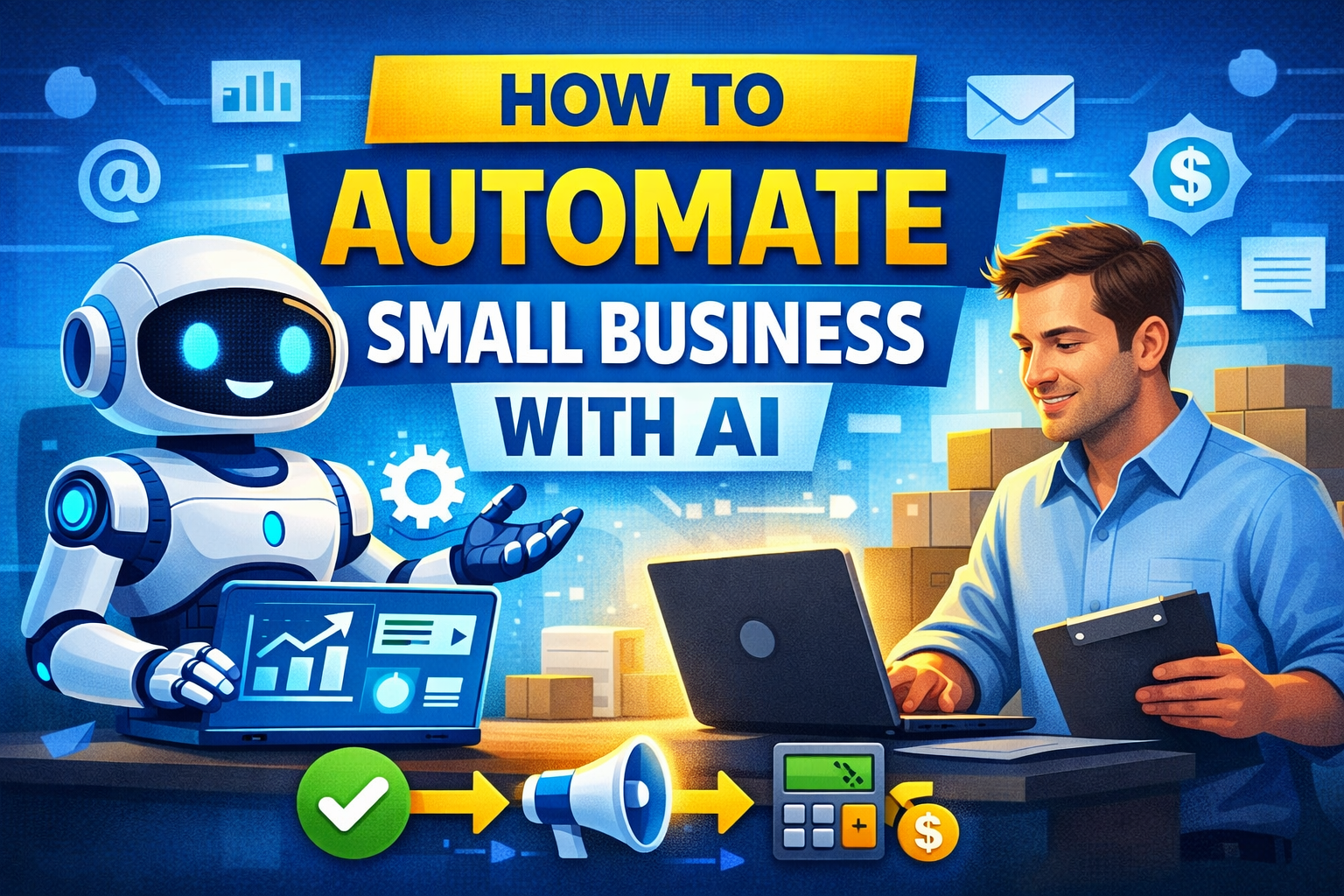
Artificial Intelligence is no longer a futuristic technology used only by large corporations. Today, small businesses can use AI to automate daily operations, reduce workload, improve efficiency, and scale faster without hiring large teams.
Running a small business is challenging. Entrepreneurs often handle multiple responsibilities such as customer service, marketing, accounting, scheduling, and inventory management. Many of these tasks are repetitive and time-consuming.
This is where AI automation for small businesses becomes extremely valuable.
AI tools can automate repetitive tasks, analyze data faster than humans, and provide intelligent recommendations that help businesses grow faster.
In this comprehensive guide, you will learn:
- What AI automation is
- Why small businesses should use AI
- Step-by-step process to automate business operations
- Practical examples of AI use cases
- Copy-and-paste AI prompts you can use immediately
By the end of this article, you will understand how to implement AI automation in your small business even if you have no technical background.
What is AI Automation in Small Businesses?
AI automation refers to using Artificial Intelligence tools to perform tasks automatically without constant human involvement.
These tools use technologies such as:
- Machine learning
- Natural language processing
- Data analytics
- Predictive algorithms
AI systems can learn from data and perform tasks such as:
- Answering customer questions
- Writing marketing content
- Managing leads
- Tracking expenses
- Scheduling meetings
- Generating reports
Instead of spending hours on repetitive tasks, AI tools can complete them within seconds.
This allows business owners to focus on strategy, growth, and innovation.
Why Small Businesses Should Use AI Automation
AI adoption among small businesses is growing rapidly because it offers several advantages.
1. Saves Time
Small business owners spend a significant amount of time on repetitive administrative tasks.
AI automation can handle tasks like:
- Email replies
- Customer support
- Social media posting
- Data entry
- Report generation
This frees up valuable time.
2. Reduces Operational Costs
Hiring employees for repetitive tasks can increase business costs.
AI tools can perform many of these tasks automatically, helping businesses reduce staffing expenses and operational costs.
3. Improves Customer Experience
AI chatbots can provide instant responses to customers 24/7.
Customers no longer have to wait for business hours to receive help.
This improves:
- customer satisfaction
- response time
- service quality
4. Increases Productivity
AI tools allow employees to focus on high-value tasks rather than repetitive work.
For example:
Instead of manually sending follow-up emails, AI can automatically manage lead nurturing campaigns.
5. Enables Data-Driven Decision Making
AI systems analyze business data quickly and provide insights such as:
- customer behavior trends
- marketing performance
- sales forecasts
- operational efficiency
These insights help business owners make better decisions.
Step 1: Identify Tasks That Can Be Automated
The first step to implementing AI in your business is identifying repetitive tasks that consume time.
Automation works best for tasks that follow predictable patterns.
Common Tasks Small Businesses Automate
Here are some operations that can easily be automated using AI.
- Customer support responses
- Email management
- Social media scheduling
- Invoice generation
- Data entry
- Appointment booking
- Inventory tracking
- Lead follow-ups
- Customer feedback analysis
Start by identifying tasks that:
- take a lot of time
- follow the same process repeatedly
- require minimal decision-making
Example
If you run an online store, customers may repeatedly ask questions such as:
- Where is my order?
- What is your return policy?
- How long does shipping take?
Instead of answering these questions manually, an AI chatbot can handle them automatically.
AI Prompt to Identify Automation Opportunities
You can use the following prompt to identify automation opportunities in your business.
AI Prompt: Business Automation Analysis
Act as a business automation consultant.

Analyze my small business operations and identify tasks that can be automated using AI.

Business type: [Insert your business type]

Provide:

1. List of repetitive tasks
2. Tasks suitable for AI automation
3. Estimated time savings
4. Recommended AI tools
Step 2: Choose the Right AI Tools
Once you identify automation opportunities, the next step is selecting the right AI tools.
There are hundreds of AI tools available today, but not all of them are suitable for small businesses.
The key is choosing tools that are:
- easy to use
- affordable
- scalable
- compatible with your existing systems
Categories of AI Tools for Small Businesses
1. AI Customer Support Tools
These tools automate customer communication.
Features include:
- chatbot responses
- automated ticket handling
- FAQ automation
- customer query management
2. AI Marketing Tools
AI marketing tools help create and manage campaigns automatically.
Capabilities include:
- generating social media posts
- writing blog articles
- creating ad copy
- analyzing audience behavior
3. AI Content Creation Tools
These tools assist with creating digital content quickly.
They can generate:
- blog posts
- product descriptions
- email campaigns
- website copy
4. AI Accounting Tools
Financial automation tools help businesses manage finances efficiently.
These tools can:
- generate invoices
- track expenses
- categorize transactions
- create financial reports
5. AI Workflow Automation Tools
Workflow tools connect different applications and automate processes between them.
For example:
Website form submission → CRM update → automated email sent.
AI Prompt: Find the Best AI Tools for Business Automation
Act as a technology consultant for small businesses.

Recommend the best AI tools for automating my business.

Business type: [Insert business]

Tasks to automate:
[List tasks]

Provide:

1. Tool name
2. Key features
3. Pricing estimate
4. Advantages
5. Best use case
Step 3: Automate Customer Support with AI Chatbots
Customer support is one of the easiest areas where AI can be implemented.
AI chatbots can interact with customers in real time and provide instant answers.
What AI Chatbots Can Do
AI chatbots can perform many tasks such as:
- answering common questions
- guiding customers through purchases
- collecting customer information
- booking appointments
- tracking orders
- recommending products
The biggest advantage is 24/7 customer support availability.
Example
An online store chatbot can answer questions like:
- Where is my order?
- What payment methods do you accept?
- Do you offer refunds?
Instead of waiting for a human response, customers get instant assistance.
AI Prompt: Customer Support Chatbot Responses
Act as a customer support automation expert.

Create chatbot responses for my business FAQs.

Business type: [Insert business]

Common questions:

1. Order tracking
2. Shipping time
3. Return policy
4. Product availability

Responses should be friendly, professional, and helpful.
Step 4: Automate Marketing Activities
Marketing is essential for business growth, but it requires continuous effort.
AI can automate many marketing activities, allowing businesses to maintain consistent marketing without hiring large teams.
Marketing Tasks AI Can Handle
AI tools can automate:
- social media posts
- blog content creation
- email marketing campaigns
- ad copy generation
- SEO keyword research
- audience analysis
Example
Instead of manually creating daily posts, AI can generate 30 days of social media content in minutes.
This ensures consistent marketing presence across platforms.
AI Prompt: 30 Days Social Media Content Generator
Act as a social media marketing expert.

Create 30 days of engaging social media posts for my business.

Business type: [Insert business]
Target audience: [Describe audience]
Platform: [Instagram / Facebook / LinkedIn]

Each post should include:
Caption
Hook
Hashtags
Call-to-action
Step 5: Use AI for Sales and Lead Management
AI can improve sales processes by managing leads more efficiently.
Many businesses lose potential customers because they fail to follow up quickly.
AI automation ensures that leads are contacted immediately.
How AI Improves Sales
AI tools can:
- capture leads from websites
- score leads based on interest level
- send automated follow-up emails
- recommend products
- analyze buying patterns
This ensures sales teams focus on high-quality leads instead of manual data entry.
Example Sales Automation Workflow
Website visitor fills contact form
↓
AI records lead in CRM
↓
Automated welcome email sent
↓
Sales team receives notification
↓
Lead nurturing campaign begins
AI Prompt: Sales Follow-Up Email Sequence Generator
Act as a sales automation specialist.

Write a sequence of 5 follow-up emails for leads interested in my product.

Business type: [Insert business]
Product: [Describe product]

Emails should:
Build trust
Address objections
Highlight benefits
Encourage purchase
Step 6: Automate Accounting and Financial Tasks
Financial management is another area where AI automation provides huge benefits.
Manual accounting can be time-consuming and prone to errors.
AI accounting tools simplify financial management.
Financial Tasks AI Can Automate
AI tools can:
- generate invoices automatically
- track expenses
- categorize transactions
- send payment reminders
- create financial reports
Automation ensures financial records remain organized and accurate.
AI Prompt: Small Business Financial Analysis
Act as a financial analyst for small businesses.

Analyze my business financial data.

Revenue: [Insert amount]
Expenses: [Insert amount]
Profit: [Insert amount]

Provide:
Financial health summary
Cost reduction strategies
Revenue growth suggestions
Step 7: Automate Business Workflows
Workflow automation connects multiple systems and eliminates manual coordination between tools.
This improves operational efficiency significantly.
Example Workflow Automation
Customer submits website form
↓
Lead automatically stored in CRM
↓
Welcome email sent
↓
Sales team notified
↓
Follow-up campaign begins
This entire process can happen automatically without human intervention.
AI Prompt: Business Workflow Automation Planner
Act as a business process automation expert.

Design automated workflows for my business.

Business type: [Insert business]

Create workflows for:
Lead generation
Customer onboarding
Marketing campaigns
Order processing

Explain each workflow step by step.
Step 8: Monitor Automation Performance
AI automation is not a one-time setup.
Businesses should regularly monitor performance and optimize processes.
Key Metrics to Track
Important performance indicators include:
Time saved through automation
Customer response time
Lead conversion rate
Marketing campaign performance
Operational efficiency
Monitoring these metrics helps businesses refine their automation strategy.
Best Areas Where Small Businesses Can Use AI
AI automation works best in areas that involve repetitive tasks.
Customer Support
AI chatbots provide instant customer assistance.
Marketing
AI tools generate content and manage campaigns.
Sales
AI systems manage leads and analyze customer behavior.
Finance
Accounting automation reduces manual financial management.
Operations
Workflow automation improves internal efficiency.
Common Mistakes When Implementing AI
Although AI automation offers many benefits, businesses should avoid common mistakes.
Automating Too Many Processes at Once
Start with a few processes and gradually expand automation.
Using Too Many Tools
Too many tools can create complexity rather than efficiency.
Ignoring Human Oversight
AI should assist human decision-making, not replace it completely.
Poor Tool Integration
Always choose tools that integrate well with existing systems.
The Future of AI in Small Businesses
AI adoption among small businesses is expected to grow significantly in the coming years.
Advancements in AI technology will make automation even more accessible and affordable.
Businesses that adopt AI early will gain a competitive advantage by:
- reducing operational costs
- improving productivity
- delivering better customer experiences
AI is not just a technological trend — it is becoming an essential business tool.
Final Thoughts
AI automation is transforming how small businesses operate.
By identifying repetitive tasks, selecting the right tools, and implementing automation gradually, businesses can dramatically improve efficiency and productivity.
The most successful businesses will be those that combine human creativity with AI intelligence.
Instead of replacing humans, AI helps businesses work smarter, faster, and more efficiently.
If used correctly, AI can become one of the most powerful tools for scaling a small business in the modern digital economy.